Dear Dr. Husák


In this week’s Substack and the next, let’s explore two major essays from Havel’s dissident years that circulated clandestinely at home and without delay in the Western press. They were vastly influential. Today we’ll look at his open letter, “Dear Dr. Husák,” addressed to the president of Czechoslovakia and head of the communist party in 1975. The second essay, “The Power of the Powerless” (1978), has attained classic status, taught at universities, memorably cited by the Canadian prime minister at the 2026 World Economic Forum. Both essays are models of clear thinking and fearless observation in depth. I have to check myself at times from admiring them strictly for aesthetic reasons, as if their sequenced insights were a dazzling flotilla of boats advancing without haste on a sunny river. Logic can be beautiful. Havel was astonishingly good at political, psychological, and social analysis long before the Velvet Revolution and the many addresses we have encountered from the years of his presidencies. He can hold his own with Machiavelli as a political visionary of acute analytical power, though Havel turned toward the sun.
In the spring of 1975, Havel shook himself free of the torpor that had enveloped the entire nation, and him also, since the Prague Spring of 1968 and what can be fairly described as the Soviet summer a few months later, when an occupying army from the nearby “fraternal nations,” dispatched by Moscow, closed down the movement toward civil liberties and “socialism with a human face” and coerced its leader, Alexander Dubček, to abandon hope of change. What followed that truly devastating moment was “normalization,” return to a standard communist regime taking instructions from Moscow, under the control of one Dr. Gustáv Husák, First Secretary of the Czechoslovak communist party and soon President, serving from 1969, at the edge of the return to airless rigidity, to 1989, the edge of the Velvet Revolution when everything changed.
Havel’s brilliant biographer, Michael Žantovský, writes that Havel wasn’t entirely inactive in the earlier 1970s, but the scale and impact of his activities were modest. Soon after he took the risk of writing and publicizing his open letter to Dr. Husák, Havel explained to an interviewer his motives for doing so. He was a known trouble maker, but he had for some time been a somewhat invisible trouble maker. That would no longer suffice.
I felt that if I said what I thought openly, I’d be contributing—perhaps—to the process of social self-awareness that I talk about in the letter. . . . In general, I believe it always make sense to tell the truth, in all circumstances.
The second reason is entirely personal: a need to somehow transcend my own predicament. For some time now I’ve been burdened by a feeling that I’ve been thrust into a predetermined, static situation, that someone, somewhere, has already described me and classified me, and that I’ve merely been accepting this passively and playing the role I’ve been handed without engaging my own imagination. I got tired of always wondering how to move in this situation, and I felt the need to stir things up, to confront others for a change and force them to deal with a situation I myself had created.
A decade later, after his long prison term, Havel returned in an interview to the topic: why did he break his own silence, and the submissive silence across the country, to write that powerful letter of dissent?
For me personally, the first noticeable break in the long and boring sentence of the 1970s was 1975. There were . . . reasons for this. First, the idea that it was time to stop being merely a passive object . . ., it was time to stop waiting to see what “they” would do and do something myself, compel them for a change to deal with something they hadn’t counted on. So I wrote a long open letter to Husák. In it, I tried to analyze the sad situation in our country; to point to the profound spiritual, moral and social crisis hidden behind the apparent tranquility of social life. I urged Husák to realize just how much he himself was responsible for this general misery. . . .
The letter . . . was a kind of autotherapy: I had no idea what would happen next, but it was worth the risk. I regained my balance and my self-confidence. I felt I could stand up straight again, and that no one could accuse me any longer of not doing anything, of just looking on in silence at the miserable state of affairs. I could breathe more easily because I had not tried to stifle the truth inside me. I had stopped waiting for the world to improve and exercised my right to intervene in that world, or at least to express my opinion about it. At the same time, it had a wider significance: it was one of the first coherent—and generally comprehensible—critical voices to be heard here, and a general response was not long in coming. Obviously I had hit a moment when all this endless waiting around had begun to get on a lot of people’s nerves, people who were tired of their own exhaustion . . . . So people copied my letter out and passed it on, and it was read by practically everyone who still cared. Naturally I was enormously pleased and encouraged by this response.
It’s striking, and beautiful, that Havel wrote his letter as one articulate intellectual to another; he paid Husák that compliment. His analysis of the situation in the country under “normalization,” imposed by Husák’s government, is exquisitely thought through and detailed. I’m unable here to summarize it faithfully, there is simply too much, and recommend that you read it alongside “The Power of the Powerless,” but still there is something to note together: four themes. There is a dark vision of the state of society, an homage to the churn and sensitivity of the living culture that could be, and then a prescient vision of what occurs when a repressed society begins to break apart owing to its artificial limitations, and finally something like a coda addressed directly to Husák, dwelling on the responsibility he bears personally for the decay of the nation. About the muffled misery of society and its causes, this passage tells us much:
Somewhere at the top of the hierarchy of pressures by which man is maneuvered into becoming an obedient member of a consumer herd, there stands . . . a concealed, omnipotent force: the state police. It is no coincidence, I suppose, that this body should so aptly illustrate the gulf that separates the ideological façade from everyday reality. Anyone who has had the bad luck to experience personally the “working style” of that institution must be highly amused at the official explanation of its purpose. Does anyone really believe that that slimy swarm of thousands of petty informers, professional narcs, complex-ridden, sly, envious, malevolent petits bourgeois and bureaucrats, that malodorous agglomeration of treachery, evasion, fraud, gossip, and intrigue “shows the imprint of the working man, guarding the people’s government and its revolutionary achievements against its enemies’ designs”? For who would be more hostile to a true workers’ government—if everything were not upside down—than your petit bourgeois, always ready to oblige and sticking at nothing, soothing his arthritic self-esteem by informing on his fellow citizens, a creature clearly discernible behind the regular procedures of the secret police as the true spiritual author of their “working style”? It would be hard to explain this whole grotesque contrast between theory and practice, except as a natural consequence of the real mission of the state police today, which is not to protect the free development of man from any assailants, but to protect the assailants from the threat which any real attempt at man’s free development poses.
There is revulsion in these lines that remains powerful—and uncharacteristic of Havel in his later years and roles. It’s good to see it here. In counterpoint to that revulsion is an homage to the creative power of culture. “Society’s self-knowledge”—who today would say such a thing? Have we become cynical, or do society and culture today drive or wander toward self-knowledge, all the same, without quite knowing it or using other words to know it? Havel’s permanent concern early and late with what he calls “social self-awareness” is notable.
The main route by which society is inwardly enlarged, enriched, and cultivated is that of coming to know itself in ever greater depth, range, and subtlety. The main instrument of society’s self-knowledge is its culture: culture as a specific field of human activity, influencing the general state of mind—albeit often very indirectly—and at the same time continually subject to its influence. . . . It is culture that enables a society to enlarge its liberty and to discover truth—so what appeal can it have for the authorities who are basically concerned with suppressing such values? They recognize only one kind of truth: the kind they need at the given moment. And only one kind of liberty: to proclaim that “truth”. . . .
Life rebels against all uniformity and leveling; its aim is not sameness, but variety, the restlessness of transcendence, the adventure of novelty and rebellion against the status quo. An essential condition for its enhancement is the secret constantly made manifest. On the other hand, the essence of authority (whose aim is reduced to protecting its own permanence by forcibly imposing the uniformity of perpetual consent) consists basically in a distrust of all variety, uniqueness, and transcendence; in an aversion to everything unknown, impalpable, and currently obscure. . . .
Havel has a way of calling things to life, as if to name with passionate clarity is enough to summon them. Here he dreams of “the restlessness of transcendence”—who knows exactly what that is, but let’s do it and find out; and of “the secret constantly made manifest”—again, I don’t know just what he means but it points toward vitality, intelligence, richness of inner life.
He is extraordinarily prescient about the resistance to oppression, as if he were describing an event that had already come to pass: the future Velvet Revolution.
A secret streamlet trickles on beneath the heavy lid of inertia and pseudo-events, slowly and inconspicuously undercutting it. It may be a long process, but one day it must happen: the lid will no longer hold and will start to crack. This is the moment when once more something visibly begins to happen, something truly new and unique . . . that makes us no longer indifferent to what occurs and when—something truly historic. . . . Where for years we had been denied the slightest, most ordinary surprise, life is now one huge surprise. . .
Havel goes out of his way to recognize that Husák doesn’t govern alone: there are many around him setting and executing policy, he is subject to Soviet control. But all that said, Husák is responsible.
You help to determine the climate in which we all have to live. . . . So far, it is the worst in us which is being systematically activated and enlarged—egotism, hypocrisy, indifference, cowardice, fear, resignation and the desire to escape every personal responsibility, regardless of the general consequences. . . . So far, you and your government have chosen the easy way out for yourselves, and the most dangerous road for society: the path of inner decay for the sake of outward appearances, of deadening life for the sake of increasing uniformity; of deepening the spiritual and moral crisis of our society, and ceaselessly degrading human dignity for the puny sake of protecting your own power.
Yet even within the given limitations, you have the chance to do much towards at least a relative improvement in the situation.
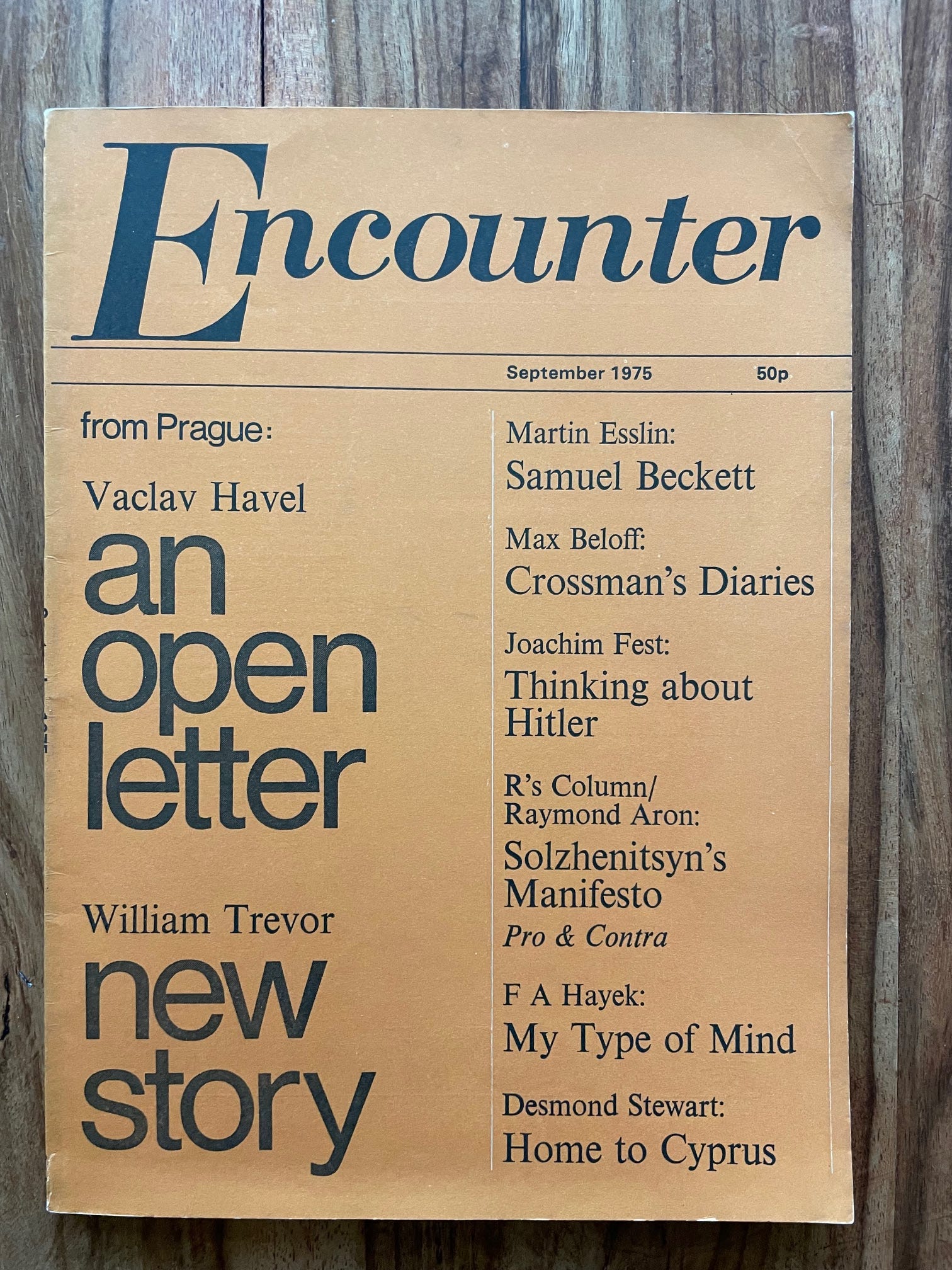
Havel mailed off his letter to Dr. Husák through the ordinary postal service and simultaneously dispatched it through a hidden channel to the West, where it was published in English in Encounter (December 1975). Husák never responded.
I don’t want to leave Dr. Husák (1913 – 1991) as an uncharacterized bureaucrat in the fixed communist mold, though photographs tend that way. A dedicated communist from an early age, a lawyer and government man, he had lived through a school of immensely hard knocks during the war and after, spending something like six years in a Czechoslovak jail on charges of being a “bourgeois nationalist.” Later reinstated to the party and government service, he had at first supported the Prague Spring of 1968 but turned against it as soon as the Soviets turned against it. His star quickly rose. A trusted Czech historian, Vilém Prečan, offers us the last word: “I can’t say that he made any positive contribution. And he is forgotten. The era of Husák’s normalization was a black time in the Czech and Slovak past. He has been forgotten, and I think that is his great punishment.”
Sources for this Substack: “Dear Dr. Husák” appears (with “The Power of the Powerless”) in Havel’s Open Letters: Selected Writings, which also includes the 1975 interview; the later interview is in his Disturbing the Peace (pp. 122 – 23). Vilém Prečan’s “Gustáv Husák: Czech History’s Forgotten Man” will be found online in the transcript of a 2004 broadcast by Radio Prague International.
Excoriating—and apt for today’s situation at home